Saturday, 31 May 2014
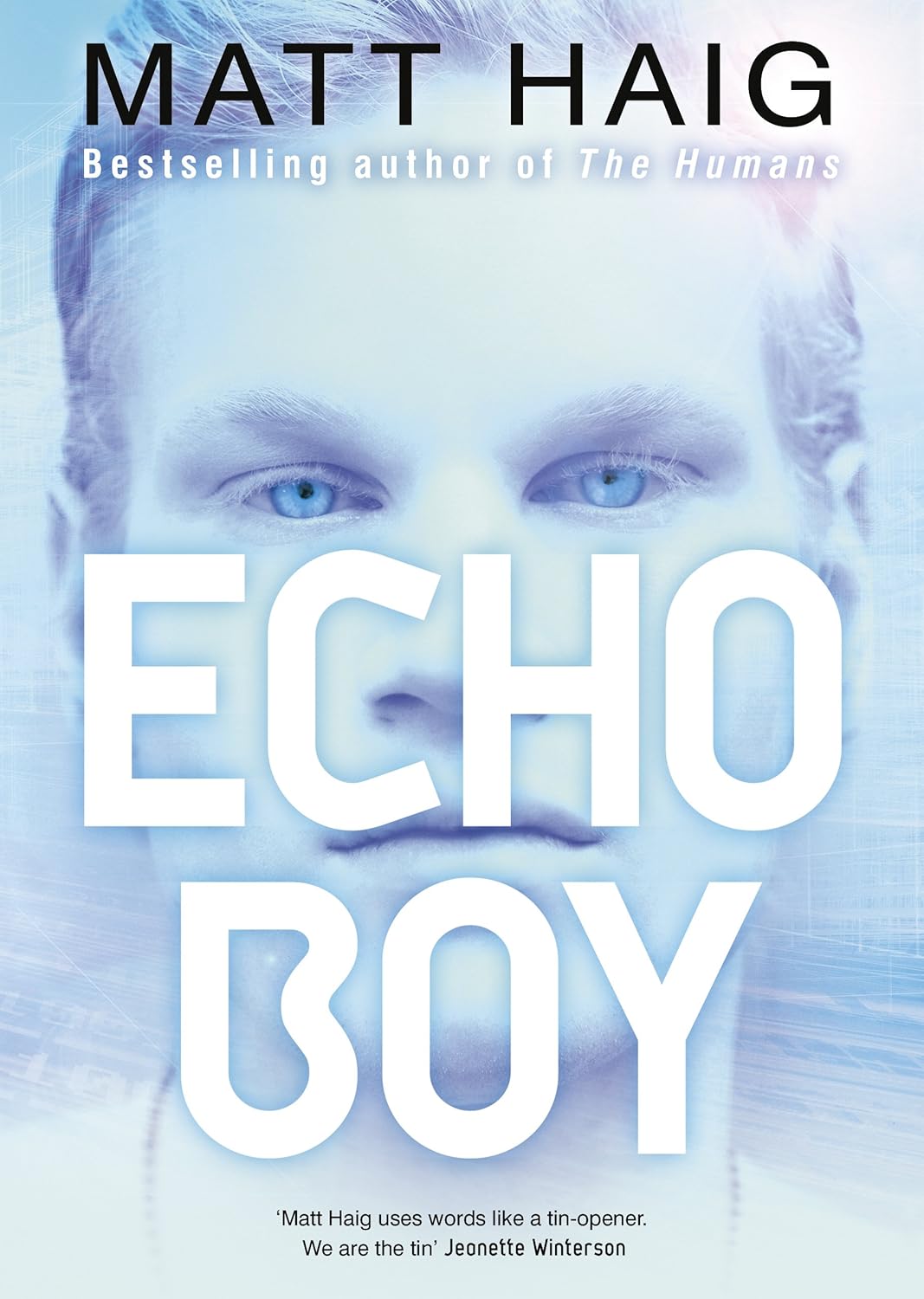
Hearing Something New In 'Echo Boy'
I will begin this with a fact that may or may not surprise you: I have never read 'The Hunger Games'. It was not like I was staunchly against it, I just never seemed to get around to it. I do like dystopian fiction, after all 'Never Let Me Go' is one of my all time favourites, but the YA ones seem to have passed me by a little. This is why I was really glad that I got the chance to read Matt Haig's 'Echo Boy', a really stirring book about a society questioning what counts as human.
One of the first things you notice when reading 'Echo Boy' is its writing style, which is frankly magnetic. Matt Haig's way of a depicting a fractured half human consciousness is so real and so heart-wrenching at points that I didn't know whether to create an award for its writer or throw pillows at him for making me so sad inside. Daniel's narrative is really endearing and Audrey works well as she stands as a support with Daniel, but is still equal to him. As I said about 'Trouble', I'm a fan of split narratives, particularly because I think it really helps the pace control-wise, and with Daniel and Audrey it really enhanced the "two sides, same coin" theory. Whilst I'll admit the 'opposites attract' theory was not working at necessarily its strongest here, the way the narratives interweave, and the way logical thinking and emotional response act in them, was really quite fantastic.
The plot of this novel is not the most original or unexpected one I will admit (I mean, since Hamlet we've known that Uncle's are always evil), and there are some issues with the romance element of it, at least for me. I think more than anything, this book struggles from being a few chapters short of perfect. It needed just a little more establishment for the romance, only a little, but it would have really pushed that area from good to great. Saying that, the other areas of the novel certainly mask this element, particularly the concept of echoes at all. The creation of this dystopia is a master-stroke by Matt Haig, but it stands so beautifully because of its surrounding problems, which echo (yes, pun intended) even today. The human debate in the novel originally worried me. It risked running into the territory of cliche and being honest, I am hipster for "urgh, I've heard that before". But it was so well handled in this novel I couldn't resist. Daniel still holds enough automated response to be robot but enough fear (not love) to be human. It's another brilliant plan by Matt Haig that is pulled off near flawlessly.
Before reading 'Echo Boy', dystopian fiction was, I'll admit, a bit of a back thought on a long list of things to try. However, I am thoroughly converted to it by Matt Haig's novel, with a terrifying world of a future that seems all too possible. His style stands a testament to his talent and I was hooked from page one. I'd highly recommend this to anyone who's looking for a rollacoaster read.
Labels:
book,
book review,
echo Boy,
echoboy,
Matt Haig,
ya fiction
Friday, 23 May 2014
Getting into 'Trouble' By Non Pratt
I have read a fair few teenage pregnancy books in my school
years. As a constant thing that you’re insensitively warned about at an
all-girls school (alongside eating disorders and the devil itself, s-e-x) it
was a topic covered by about a quarter of the books in the library. This is
partly why I was so interested to see in what direction Non Pratt’s ‘Trouble’
would take the well-used story arc, and, I can happily say, I was not disappointed.
One of my favourite aspects of this book is its (finally!) non-Mary-Sue protagonist. Hannah is not a perfect angel by any means or definition. She’s selfish, she’s sharp-tongued, but, what I think is the most important thing, she has had sex with more than one person. Her pregnancy is not the result of a single fall from grace (well, not directly) but her simply being sexually active and careless once, out of many times in which she has been safe and careful. She doesn’t stand as a poor spoilt virgin, a dangerous image we see far too often in teen fiction, but a real teenager. I have made this comment before: I would rather read a book with characters that sometimes drive me crazy but act like real, and often irrational, teenagers, than those who form immaculate and adult impressions of teens. Hannah lives in a world where she drinks in the park on Friday nights, smokes cigarettes, and has sex through her own agency and choice (and, in some sections, doesn’t have sex through her own agency and choice). Yet she doesn’t seem to be out-of-control reckless like a daunting Skins character, simply acting like a teenager would, experimenting with her own boundaries, and the boundaries set around her.
The style with which Pratt writes is really a reason to read the book in itself. The multi-perspective narrative in it truly works to its strength. It is often flipping through the same conversation in Aaron and Hannah’s minds and this had a profound effect on the conversation itself, even at points making it more heart breaking. Pratt’s style of writing dialogue and choreographing events in the present gave the book one hell of a pace, one which meant I was whisked along the story with its characters, with only moments of revelation to stop me in my tracks. This, in combination with her clever characters and twist-turn plot, creates a fantastic read.
I could still nit-pick at this book for a few things, but I would be nit-picking as a near fine art. I found Aaron’s background vey over-dramatised, partially by its mystery through most of the novel, and I was disappointed that we didn’t see more of the consequences of Hannah’s pregnancy for other members of both her and Aaron’s family (Aaron’s Dad is a teacher at that school and no one seemed to care?). However, a more blue sky thinking part of my rather split mind wonders if that was part of the idea. My comment on multi-perspective narrative in a previous review (of the book Wonder) was very positive, because it allowed the reader to get a full picture of the main character’s life, whereas I think in ‘Trouble’, we see only Hannah and Aaron’s views because that is the degree to which their problems can be expressed. Through other’s eyes, Hannah’s pregnancy is a mistake and Aaron’s crisis over his old friend is simply grief, but that is not a lens that Pratt provides us with. We are restricted in these perspectives in order to understand a more personal version of events, a version that cannot be given by anyone but Aaron and Hannah.
I thought I may have been done with teenage pregnancy style stories, but the reason that ‘Trouble’ is so good is because it is so much more than that. It is a teenage story, involving pregnancy, but it’s much more a bildungsroman than a simple 9 month diary. With Aaron’s story working in conjunction with Hannah’s, a brilliant, three-dimensional and charming novel is created.
One of my favourite aspects of this book is its (finally!) non-Mary-Sue protagonist. Hannah is not a perfect angel by any means or definition. She’s selfish, she’s sharp-tongued, but, what I think is the most important thing, she has had sex with more than one person. Her pregnancy is not the result of a single fall from grace (well, not directly) but her simply being sexually active and careless once, out of many times in which she has been safe and careful. She doesn’t stand as a poor spoilt virgin, a dangerous image we see far too often in teen fiction, but a real teenager. I have made this comment before: I would rather read a book with characters that sometimes drive me crazy but act like real, and often irrational, teenagers, than those who form immaculate and adult impressions of teens. Hannah lives in a world where she drinks in the park on Friday nights, smokes cigarettes, and has sex through her own agency and choice (and, in some sections, doesn’t have sex through her own agency and choice). Yet she doesn’t seem to be out-of-control reckless like a daunting Skins character, simply acting like a teenager would, experimenting with her own boundaries, and the boundaries set around her.
The style with which Pratt writes is really a reason to read the book in itself. The multi-perspective narrative in it truly works to its strength. It is often flipping through the same conversation in Aaron and Hannah’s minds and this had a profound effect on the conversation itself, even at points making it more heart breaking. Pratt’s style of writing dialogue and choreographing events in the present gave the book one hell of a pace, one which meant I was whisked along the story with its characters, with only moments of revelation to stop me in my tracks. This, in combination with her clever characters and twist-turn plot, creates a fantastic read.
I could still nit-pick at this book for a few things, but I would be nit-picking as a near fine art. I found Aaron’s background vey over-dramatised, partially by its mystery through most of the novel, and I was disappointed that we didn’t see more of the consequences of Hannah’s pregnancy for other members of both her and Aaron’s family (Aaron’s Dad is a teacher at that school and no one seemed to care?). However, a more blue sky thinking part of my rather split mind wonders if that was part of the idea. My comment on multi-perspective narrative in a previous review (of the book Wonder) was very positive, because it allowed the reader to get a full picture of the main character’s life, whereas I think in ‘Trouble’, we see only Hannah and Aaron’s views because that is the degree to which their problems can be expressed. Through other’s eyes, Hannah’s pregnancy is a mistake and Aaron’s crisis over his old friend is simply grief, but that is not a lens that Pratt provides us with. We are restricted in these perspectives in order to understand a more personal version of events, a version that cannot be given by anyone but Aaron and Hannah.
I thought I may have been done with teenage pregnancy style stories, but the reason that ‘Trouble’ is so good is because it is so much more than that. It is a teenage story, involving pregnancy, but it’s much more a bildungsroman than a simple 9 month diary. With Aaron’s story working in conjunction with Hannah’s, a brilliant, three-dimensional and charming novel is created.
Friday, 16 May 2014
Back With A Bang: 'Sally Heatcote: Suffragette'
First, I must begin this blog with an apology and that is an
apology for my absence for what does feel like absolutely forever, but is
actually 2 weeks. This is owing to a huge workload and a lot of stress over the
past month, and I hope you will all forgive me. And so, in order to make it up
to you, I decided to do something a little different this week. This week I
will be reviewing ‘Sally Heathcote: Suffragette’ by Mary M Talbot, Kate
Charlesworth and Bryan Talbot. This graphic novel caught my eye in Forbidden
Planet, and, thinking it might quite interesting, I thought I’d give it a shot.
After reading? Interesting does not even begin to cover how much I enjoyed it.
I’ll begin with the narrative of the tale; it’s a clever depiction of a working class girl’s experiences with the suffragette movement and the Pankhurst family in general, mainly depicting her fervour and then disillusionment with said movement, and the desperation and fight that women faced at the time. I have read political graphic novels before (if you’re into that kind of thing, track down ‘Cuba: My Revolution’, it’s truly fab), and one of their true talents is telling a side of a story that isn’t so far publicised. When being taught about the suffragettes, most people remember the violence, but the idea that there was any other kind of suffragette but a militant one is something that I think so few people learn. Hell, even I was learning about them, I developed an unhealthy interest with Emily Davidson throwing herself under a horse, before realises that the famous Sylvia Pankhurst was actually a pacifist, but I digress. The protagonist Sally really, at first, believes in the militancy of her movement, a true follower of Christabel Pankhurst, and it is this very belief that makes her growing distaste of it all the more real and her separation from the movement all the more saddening to read. Sally creates a complicated image of the suffragette, a warrior who realises the true damage of some of her actions, which helps us as readers realise that the history we know of heroes and villains, freedom-fighters versus terrorists, is not a complete history, merely one aspect of a far more complex issue.
Another point I have to make about this book, mainly because it would be a crime to Kate Charlesworth if I didn’t, is that its illustration is not only beautiful, but really adds another layer to the story. The pages contain a muted colour palette, with only the WSPU colours (green, white and purple, before you wiki it) and Sally’s bright orange hair used to break the grey and white frames. There are a few exceptions to this rule, for example the passage which is set entirely in candlelit darkness, but overall the effect of this is staggering. My own personal favourite element of the illustration was the metamorphic sequences representing the cat and mouse act, which really demonstrated the predatory and threatening nature of politics of the time towards the women’s suffrage movement. I also greatly enjoyed the realistic portrayals of women in it (no Barbies or manic pixie dream girls, woohoo!), who all came across as having the appearance of real women, something that a LOT of times is missed from graphic novels with attempts at realism.
Overall, I have very little to criticise with this one (not that that is very new, but still). It portrays an interesting view of history, beautifully and (equally importantly) accurately, with a stack of references and notes at the back, which, if you’re a bit of a nerd like me and want to re-read with all the footnotes, is fascinating. Which is what I did promptly after reading. Twice.
I’ll begin with the narrative of the tale; it’s a clever depiction of a working class girl’s experiences with the suffragette movement and the Pankhurst family in general, mainly depicting her fervour and then disillusionment with said movement, and the desperation and fight that women faced at the time. I have read political graphic novels before (if you’re into that kind of thing, track down ‘Cuba: My Revolution’, it’s truly fab), and one of their true talents is telling a side of a story that isn’t so far publicised. When being taught about the suffragettes, most people remember the violence, but the idea that there was any other kind of suffragette but a militant one is something that I think so few people learn. Hell, even I was learning about them, I developed an unhealthy interest with Emily Davidson throwing herself under a horse, before realises that the famous Sylvia Pankhurst was actually a pacifist, but I digress. The protagonist Sally really, at first, believes in the militancy of her movement, a true follower of Christabel Pankhurst, and it is this very belief that makes her growing distaste of it all the more real and her separation from the movement all the more saddening to read. Sally creates a complicated image of the suffragette, a warrior who realises the true damage of some of her actions, which helps us as readers realise that the history we know of heroes and villains, freedom-fighters versus terrorists, is not a complete history, merely one aspect of a far more complex issue.
Another point I have to make about this book, mainly because it would be a crime to Kate Charlesworth if I didn’t, is that its illustration is not only beautiful, but really adds another layer to the story. The pages contain a muted colour palette, with only the WSPU colours (green, white and purple, before you wiki it) and Sally’s bright orange hair used to break the grey and white frames. There are a few exceptions to this rule, for example the passage which is set entirely in candlelit darkness, but overall the effect of this is staggering. My own personal favourite element of the illustration was the metamorphic sequences representing the cat and mouse act, which really demonstrated the predatory and threatening nature of politics of the time towards the women’s suffrage movement. I also greatly enjoyed the realistic portrayals of women in it (no Barbies or manic pixie dream girls, woohoo!), who all came across as having the appearance of real women, something that a LOT of times is missed from graphic novels with attempts at realism.
Overall, I have very little to criticise with this one (not that that is very new, but still). It portrays an interesting view of history, beautifully and (equally importantly) accurately, with a stack of references and notes at the back, which, if you’re a bit of a nerd like me and want to re-read with all the footnotes, is fascinating. Which is what I did promptly after reading. Twice.
Friday, 25 April 2014
REWIND: 'Pretty Things' by Sara Manning
I am always surprised when I realise how old books I read as a teenager are now by the technicality of years. ‘Pretty Things’ by Sara Manning was a book that really changed my perspective at the age of 15, and now I am suddenly realising it was first published in 2005, nearly 10 years ago. This, whilst frightening the hell out of me, also placed the book in a time frame of developing attitudes, and was something that I really hadn’t taken into account when I read it the first time round.
‘Pretty Things’ is a really interesting depiction of teenage sexuality, and is still one of the only books (hold on to your hats, this is the book’s crowning glory) that portrays sexuality as a fluid thing, particularly in teenagers, and really highlights how damaging the block labels of gay, straight, and bisexual can be. Centred around Brie, Charlie, Walker and Daisy’s drama group’s production of ‘The Taming of The Shrew’ (described by the hard-core Daisy as “the biggest pile of misogynistic wank”, and as an English student, I support her in this), we see these characters explore their own and each other’s attraction towards each other, in a far more realistic way than I think my older self would like to believe. Looking back at what I knew of teenage life and the importance of who you were attracted to and who you kissed, taking into account the time the book is written, I had to face the fact that the way the characters act is likely more realistic than this cringing reviewer would like to believe. It was when sexuality had only just become an acceptable thing to mention in schools, and though a still pretty homophobic environment, there was a huge amount of dubbing yourself as “gay” being like a celebrity scandal: you were the talk of everyone for a few weeks, you felt like Katy Perry, and then you wrote it off as a mistake and pretended it didn’t happen. It was horrifically disheartening and cruel to those actually suffering crises of their sexuality. Whilst re-reading this book, and, as far as I recall, reading it the first time, I nearly put it down within the first few chapters, as the initial depictions of the characters as gay boy, straight girl, straight boy and lesbian were such incredible stereotypes. But realising that Manning was setting them up to knock them down is only a journey I can appreciate more in a re-read.
This may the book’s greatest strength and, at the same time, its greatest flaw. I’m lucky and happy to say I made it past the opening character profiles, but this was mainly owing to the humour in the book (their darling drama teacher was edging for my favourite character spot in the first few chapters), and whilst I’m glad I held on, I can’t help but think about those that didn’t. This book really does show the breaking of those stereotypes, and how those stereotypes of sexuality are built into young people, and how they believe that sexuality is a rigid idea, no grey area, just simple categories. The problem was that it doesn’t show this to you until the romantic entanglements start getting a little complicated. This delay really could have put me off the book quite easily, particularly as Brie’s character was very wearing at first, and I wasn’t too pleased about Daisy either. I’ll be honest, portrayal of women is not the strong point of ‘Pretty Things’, but I can at least see where Manning was aiming for with it, even if she didn’t succeed. There are exceptions to this, for example, in a scene where Brie is nearly sexually assaulted towards the end of novel, and the gang come up to save her, Brie is already beginning to fight off her attacker, although this moment is slightly blotted by the need for the boys, Walker and Charlie, to beat the guy up in penance for his actions. “Bizarre macho display” indeed Charlie.
Overall, I am really glad to have been able to read this book again. It brightened me a little to think of how far teenage (and adult for that matter) thinking on portraying and understand of sexuality in novels, especially YA novels, had come even back in 2005. I do worry a little at the amount of tokenised characters one tends to see in media and literature aimed at children and young people, so it always raises my optimism bar to remind myself it may not all be like that.
Labels:
book,
book review,
pretty things,
review,
rewind,
sara manning
Friday, 18 April 2014
Friends Definitely Let Friends Read - 'Team Human' by Sarah Rees Brennan and Justine Larbalestier
A few weeks ago, I reviewed Holly Black’s clever twist on
the typical vampire idealism with her fantastic fantasy ‘The Coldest Girl inCold Town’. This week, I wanted to review to review ‘Team Human’ by Sarah Rees
Brennan and Justine Larbalestier, another YA vampire variation, before the
little voice in the back of my head chimed in. “Too similar Frankie, too, too similar.”
No, I answered the voice, I want my readers to keep Holly Black in mind when
they read this, I want them to share my experience of echoes and the spotting
of key differences and similarities, creating the same fascinating comparing
experience that happened to me. The voice in the back of my head shrugged and
sulked, but it said okay, so here goes.
‘Team Human’ is another book I really stumbled into in an odd sort of way, and was rather perplexed by. The first point of it that really got me twisting my hair round my fingers in confusion was that vampires in this book are not all that great (at least to the narrator Mel). In every fantasy I have read, the fantasy characters, although always an ‘other’ to the human, and usually dangerous, are glamorous, fixated upon, and above all, longed for (even if it’s a creepy, maybe-yes-maybe-no way). In ‘Team Human’, vampires appear far more like bored individuals, an aging population with nothing particularly vicious about them, barring a few exceptions. The removal of this danger from the vampires is partly just the perspective of the narrative, but, more than that, it really is a tribute to the two authors’ writing in that they make a relatively heavy thematic point in a pretty comedic fashion. The idea of ‘who is the real monster’ is not a new notion (remember Cold Town, remember the last letter which ponders whether the monster is inside all humans?) but in Team Human, instead of the monster in humans, we really see the human in the vampires.
Don’t get me wrong, this isn’t a book simply built out of parody and knitted together with happy co-operation and smiles – it, like most vampire novels, holds unto its gritty violence and a good amount of threat, but I really enjoyed the other side of this novel more. Whilst Holly Black’s earth of vampires trembled and shuddered with shadows bursting from corners, and the ever-creeping feeling of a time bomb inside the narrator ticked on, the world of ‘Team Human’ is described to be a kind of “Las Vegas”, and a lot less exciting than people seem to believe. More than anything, in this world, it is not the crisis of vampires they deal with, but the after effects, not the immediate appearance, but the prejudice and relations between humans and vampires that follows. Whilst I do prefer the thrilling terror of the Cold Town environment, I was fascinated by the rebuilt society that’s established in Sarah Rees Brennan and Justine Larbalestier’s novel.
However, although I could nit-pick for quite a while on this book for its characters, I will channel my hesitant feelings into one form and that form is the character of Cathy. At first I mistook my misgivings for personal distaste (which I will admit, I am occasionally prone to), but by a third of the way through I began to believe Cathy as a character less and less. She became vaguer and vaguer, until a sudden character break of shouting, which seemed to fade all too fast. But I am torn even now for a final decision on my irritation with this, in regards to whether Cathy is simply written like this, or whether this static nature is a deliberate point of Mel’s perspective. I do hope for the latter, and it would make some form of sense, but fear the former may simply be the explanations (Occam’s razor and all that).
Overall, I did really enjoy ‘Team Human’, demonstrated, more than anything, in the fact that I didn’t put it down (I read it in roughly two and a half hours). It probably isn’t one of the more technically ‘worthy’ novels I tend to review, but it’s exploration of a human side was something that I really haven’t come across in most kinds of fantasy, and something that keeps me a little conflicted even now.
‘Team Human’ is another book I really stumbled into in an odd sort of way, and was rather perplexed by. The first point of it that really got me twisting my hair round my fingers in confusion was that vampires in this book are not all that great (at least to the narrator Mel). In every fantasy I have read, the fantasy characters, although always an ‘other’ to the human, and usually dangerous, are glamorous, fixated upon, and above all, longed for (even if it’s a creepy, maybe-yes-maybe-no way). In ‘Team Human’, vampires appear far more like bored individuals, an aging population with nothing particularly vicious about them, barring a few exceptions. The removal of this danger from the vampires is partly just the perspective of the narrative, but, more than that, it really is a tribute to the two authors’ writing in that they make a relatively heavy thematic point in a pretty comedic fashion. The idea of ‘who is the real monster’ is not a new notion (remember Cold Town, remember the last letter which ponders whether the monster is inside all humans?) but in Team Human, instead of the monster in humans, we really see the human in the vampires.
Don’t get me wrong, this isn’t a book simply built out of parody and knitted together with happy co-operation and smiles – it, like most vampire novels, holds unto its gritty violence and a good amount of threat, but I really enjoyed the other side of this novel more. Whilst Holly Black’s earth of vampires trembled and shuddered with shadows bursting from corners, and the ever-creeping feeling of a time bomb inside the narrator ticked on, the world of ‘Team Human’ is described to be a kind of “Las Vegas”, and a lot less exciting than people seem to believe. More than anything, in this world, it is not the crisis of vampires they deal with, but the after effects, not the immediate appearance, but the prejudice and relations between humans and vampires that follows. Whilst I do prefer the thrilling terror of the Cold Town environment, I was fascinated by the rebuilt society that’s established in Sarah Rees Brennan and Justine Larbalestier’s novel.
However, although I could nit-pick for quite a while on this book for its characters, I will channel my hesitant feelings into one form and that form is the character of Cathy. At first I mistook my misgivings for personal distaste (which I will admit, I am occasionally prone to), but by a third of the way through I began to believe Cathy as a character less and less. She became vaguer and vaguer, until a sudden character break of shouting, which seemed to fade all too fast. But I am torn even now for a final decision on my irritation with this, in regards to whether Cathy is simply written like this, or whether this static nature is a deliberate point of Mel’s perspective. I do hope for the latter, and it would make some form of sense, but fear the former may simply be the explanations (Occam’s razor and all that).
Overall, I did really enjoy ‘Team Human’, demonstrated, more than anything, in the fact that I didn’t put it down (I read it in roughly two and a half hours). It probably isn’t one of the more technically ‘worthy’ novels I tend to review, but it’s exploration of a human side was something that I really haven’t come across in most kinds of fantasy, and something that keeps me a little conflicted even now.
Note to all: Hey all! I’m so very sorry for the lack of
review last week, I have been having a horrible time with work and illness,
and, unfortunately, I just couldn’t get around to the laptop or the reading. I
shall continue next week as normal!
Saturday, 5 April 2014
REWIND: The Fault In Our Stars by John Green
Rewind is a new thing I wanted to start here, in which I review books which I have re-read rather than read for the first time. Re-reading a novel is a weird experience that I know a lot of people can't always enjoy. Despite my endless enthusiasm for reading a book again and again and again, I know it is not everyone's cup of loose leaf peach and raspberry (I've always been a tea snob). I have thought about re-reading 'The Fault In Our Stars' since I read it about a year ago, and I have to be honest, it is undoubtedly still loved, but put into a little perspective after its initial assault on the feels has already been had, which drew out, for me, even more questions (and answers) about within the novel
Firstly, I began to question Hazel and Augustus' relationship a lot more (though to be fair to John Green's character construction, this was more to do with a lot of other people's quibbles with it, and I was worried I may have not noticed its lesser points initially). Oddly enough, when taking a close examination of Gus and Hazel's love, I actually enjoyed it even more. It felt comfortable but not predictable as a re-read, which I always believe to be a good sign, and I felt myself noticing the finer details of it even more. Hazel's realism of the relationship, of herself as a time bomb, did feel overdramatic at points, although, to be honest, if I was a teenager suffering from cancer, I can't exactly say that I'd be any less emotional and generally human.
This really brings me to my next point about TFIOS, and it is something I've raised before on A Midsummer Review, and that is that is portrays teenagers as teenagers. They act cliché and overly romantic, of course they do, they're teenagers, and they attempt to form themselves into individuals in a world, which is hard enough normally, but particularly in a world that tries to form them all to the "sick kid" stereotype. A lot of people have said Gus' cigarette idea is stupid and ridiculous, but what it sounded like to me? What it sounded like to me was the work of an actual teenager, trying to take a grown up and artistic take on a situation that is truly awful.
The artisan nature of the novel is pretty clear from an initial reading, but a second attempt really drives it home. Many a friend of mine will tell you, I am not a fan of some of Oscar Wilde's work, simply because some of it feels as though it is written in the hope of being quoted, which I always find quite unsettling, as it feels an author attempts to hold the book to the quotes standard, rather than vica versa. TFIOS, as much as I loved it, did reach into this territory at points, and I felt this is likely the product of writing teenagers. It's hard to make omelette without throwing in a few wistful and too-deep-for-you phrases as it were- actually wait, I think my metaphors got mixed.
All in all, a re-read of this proves to me that TFIOS holds it's ground even when a more critical eye is searching over it. I think this book is just as enjoyable on second reading, if not even more, as John Green's shining style for writing YA beams through.
Thursday, 27 March 2014
Getting A Little Chilly With ‘The Coldest Girl In Coldtown’ by Holly Black
If there is one thing that YA seems to be doing amazingly well with right now, it is fantasy. Think of Twilight (try, I know, I don’t really want to do it either), but think of the ludicrous success that came from it. I’ve always thought fantasy was a pretty brilliant genre, and loved it whilst growing up, so I thought I would publicise a far better fantasy vampire novel (it’s okay, this will erase Twilight from your brain) and that is ‘The Coldest Girl In Coldtown’ by Holly Black.
Oddly enough, when I first learnt about this book, I was having it read to me in a Foyles in Leicester Square, by Holly Black herself, with my over excited best friend next to me, gazing in awe. Originally, I barely knew Holly Black’s name, except that she wrote the Spiderwick Chronicles, which my little sister religiously believed, and Tithe, which my friend adored. It was from her reading of the chapter from ‘The Coldest Girl in Coldtown’ that my interest pricked a little, and from finally getting time to get around to reading it, I am sure as hell glad that I did. The book’s heroine, Tana, after waking up to discover that a house party she believed she embarrassed herself at has had far worse results for everyone else, sets on a journey with her ex and a stray vampire to a Coldtown, a place in which Vampires and those who are ‘Cold’ (pre-vampire) are annexed in order to protect citizens. That is the briefest summary I can give with little spoiler, but I cannot emphasise enough how this does not do the book justice.
One of the things I liked most about this book is its integration of the vampire world to the real-world, and this, in corporation with Holly Black’s understanding of the late teenage ‘alternative’ grouping, creates a really brilliant, funny, and more than anything believable story. Something that is always seems forgotten in fantasy fiction, particularly in YA, you want your reader to want to, or at least be able to imagine themselves as, a part of your fantasy world. My personal opinion is that if you create some kind of universe that the reader can’t even remotely place themselves into, you need to go back and rethink a few details. I was really immersed in the setting of this book; I could see the Coldtown, and smell the fresh-spilled blood that seemed to lurk around every corner, and I kept wondering, staring down at my Docs, if, in the event of a serious vampire crisis, they’d have thick soles enough to kick a vampire in the teeth. This may just be my over-imaginativeness talking, but the detail set this book in such a good stead that even if the characters hadn’t been as good as they were, I still would have likely loved it.
The characters, however, were the filling in a rather good version of almond sweet pastry, as they seemed to create the story, rather than the reverse. Call me crazy, but I’m never a big fan of plots dragging characters along with it like they got tied to a run away, Mary Poppins, merry-go-round horse. They functioned in really clever synchronisation, not allowing the story or its premise overwhelm them at any point, creating really intimately, well sculpted relationships between the characters as well. I have to admit the relationship of Winter and Midnight (two totally adorable children of the night who get just a little out of control) was almost flawless in the honest sense of devotion is portrayed, and I think, for me, it even rivalled the relationship of Tana and her sister Pearl. The story itself relies a lot on the concept of protection, family or friends, and the lure of selfishness, and so these relationships really hold well to the book.
Overall, I really thought this booked risked be simply an antithesis to Twilight, but it was so, SO much more. It was gripping, funny and truly tragic at points but I have to be honest, I wouldn’t ever change that ending for the world. If you want to pick this book up, I highly recommend following the Answerly ‘Let’s Read’, done by the fabulous Kristina Horner, which I link here. Enjoy all!
Quick personal note: You may notice that whilst I normally
post on Fridays (because nothing says let’s kick of the weekend like a book
review) this is a Thursday post as I am going to Kita-Con in Birmingham this
weekend, but all will return to normal next week. See you all then J
Subscribe to:
Posts (Atom)


